 thelocalbuild
Comparison
On-premise vs cloud AI
Cost, security and compliance compared, and the honest answer to when self-hosting private AI beats a cloud API.
"Should we use a cloud AI API or run it ourselves?" is one of the most consequential infrastructure decisions a team makes today. The right answer depends on three things: how sensitive your data is, how much you use AI, and how much control you need. Here is a clear-eyed comparison.
At a glance
| Cloud AI | On-premise AI | |
|---|---|---|
| Setup | Instant | Days (hardware + install) |
| Data exposure | Leaves your network | Never leaves your network |
| Cost model | Per token, ongoing | One-time hardware + operations |
| Cost at scale | Grows with usage | Fixed regardless of volume |
| Compliance | Depends on provider & contracts | Full data residency & control |
| Latency | Internet round-trip | Local (LAN) |
| Elasticity | Effectively unlimited | Fixed to your hardware |
Cost: it depends on volume
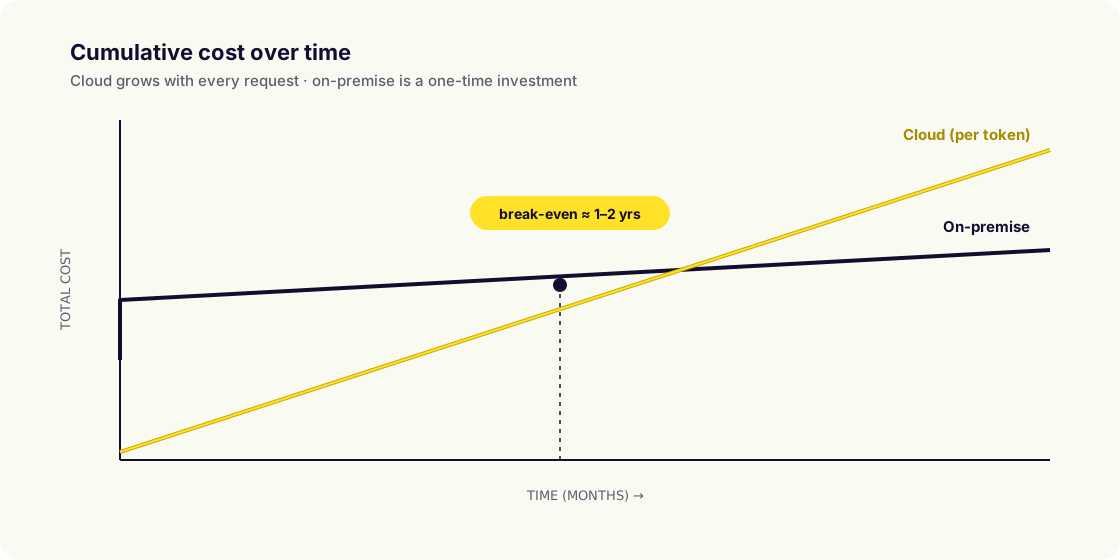
Cloud pricing is per token, so it scales linearly with usage. That is great for prototypes and spiky, low-volume workloads, you pay almost nothing when idle. But teams that use AI heavily and continuously (support automation, document processing, coding assistants across an org) can run bills into five or six figures a month.
On-premise flips the curve: you pay once for hardware and then run unlimited inference at a fixed operating cost. The crossover point, where the one-time investment becomes cheaper than accumulating cloud fees, is typically within one to two years for sustained enterprise usage. Over a 5-year hardware lifecycle, the savings compound.
Rule of thumb: occasional or unpredictable usage favours cloud; sustained, high-volume usage favours on-premise.
Security & compliance: the deciding factor
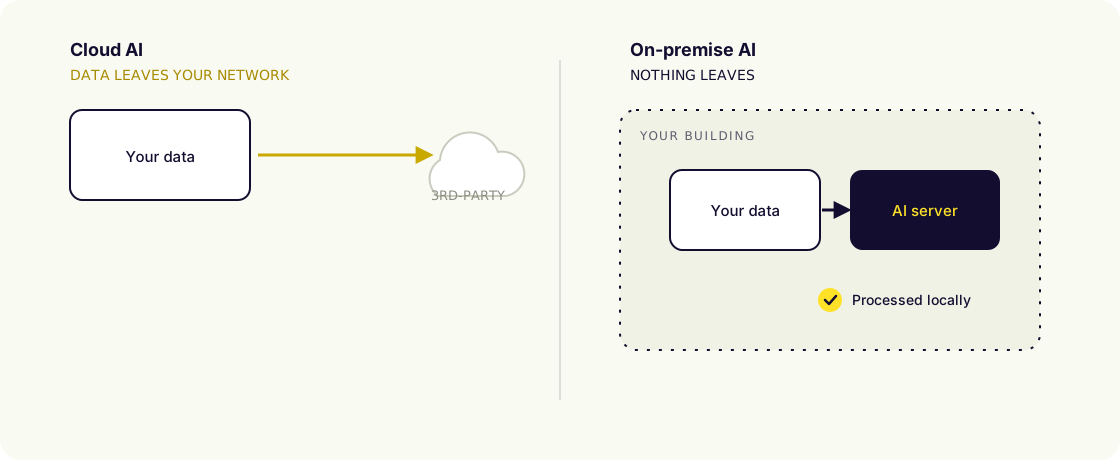
For many organisations, cost is secondary to control. With a cloud API, your prompts and documents leave your network and are processed on infrastructure you do not own. Even with strong contractual protections, that is often incompatible with:
- GDPR / DSGVO and data-residency requirements
- HIPAA and patient-data rules
- Financial, legal and defence data-governance policies
- Protecting proprietary source code and trade secrets
On-premise AI keeps every request on your own hardware, with no external interfaces and, optionally, full air-gapping. You can prove, down to the packet, that nothing left. That is why regulated industries increasingly self-host. Our on-premise AI server guide covers how this works in practice.
Control and longevity
With open-weight models you own the weights. A cloud model can be deprecated, throttled, re-priced or changed without notice; your on-premise stack keeps running exactly as-is for as long as you want, and you decide when to upgrade.
The hybrid reality
It is not always either/or. Many teams keep sensitive workloads on-premise and burst non-sensitive experiments to the cloud. The key is that anything touching regulated or proprietary data stays local by default.
Latency and reliability
Two operational factors often get overlooked. Latency: a cloud call is an internet round-trip, while on-premise inference happens on your LAN: noticeably faster and more consistent, which matters for interactive assistants and high-volume automation. Reliability: a cloud API can rate-limit you, have an outage, or deprecate the exact model your workflow depends on. An on-premise server keeps serving as long as your hardware is up, and you decide when anything changes.
Migrating from cloud to on-premise
You do not have to rip and replace. Because on-premise platforms expose an OpenAI-compatible API, migration is usually a configuration change: point your existing apps and SDKs at your internal endpoint instead of the cloud provider's. A practical path is to move your most sensitive, highest-volume workloads first (where the compliance and cost wins are biggest) and keep low-stakes experiments wherever is convenient. See running open-source LLMs on-premise for the technical detail.
Frequently asked questions
- Is on-premise AI cheaper than cloud AI?
- At low usage, no, the cloud has zero upfront cost. At sustained high volume, on-premise usually becomes cheaper within one to two years because you stop paying per token.
- Is on-premise AI more secure?
- For data control, yes: nothing leaves your network. Cloud security depends on trusting the provider's controls and contracts, which many regulated workloads can't accept.
- Can I get cloud-level convenience on-premise?
- Largely, yes: a managed on-premise platform gives you an OpenAI-compatible API and a ready UI, so developers and staff get the same experience without the data leaving.